When Loopipak develops a new reusable packaging solution, manufacturing does not take place in a conventional factory.
Instead, it is carried out in sheltered workshops. These organisations play a central role in our model: they contribute to the design, manufacturing, adjustments and industrialisation of reusable logistics solutions.
But this collaboration goes far beyond simple production. It is a co-development process, structured in several stages, that transforms an idea into a robust and sustainable logistics solution.
This article explains how Loopipak works concretely with sheltered workshops to design high-performance reusable packaging.
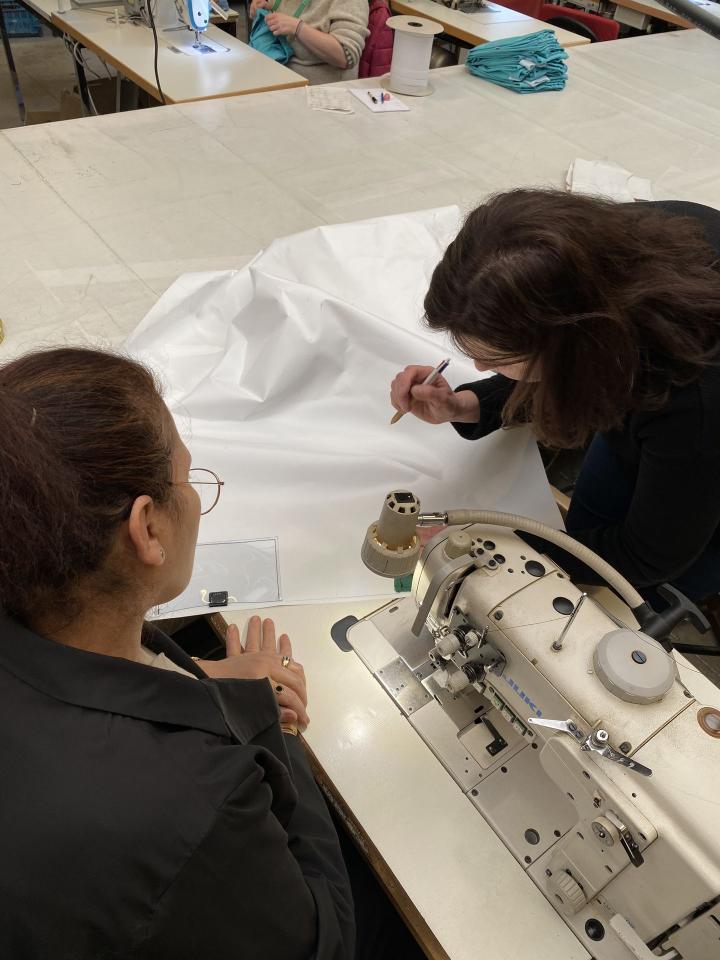
1. A collaboration based on dialogue and field expertise :
Every project begins with a discussion phase.
Even before designing the product, we exchange with the teams from sheltered workshops to understand:
- technical constraints related to manufacturing
- the types of materials used
- sewing and assembly methods
- production capabilities
This step is essential: it allows us to integrate the expertise of the manufacturing teams into the product design from the very beginning.
Sheltered workshops are not just manufacturers — they are true technical partners.
2. Technical advice to facilitate manufacturing :
During this first phase, sheltered workshops often provide valuable advice.
For example, they may recommend:
- stronger sewing techniques
- fastening systems that are easier to produce
- dimensions that simplify manufacturing
- adjustments that make the product more robust
These discussions help guide the design toward solutions that are strong, feasible and efficient in production.
3. Creation of the first prototype :
Once the first decisions have been made, the sheltered workshop produces a prototype.
This prototype transforms the plans and ideas into a real product.
This is an important step because it allows us to verify:
- the strength of the product
- ease of use
- the quality of the assemblies
- consistency with logistics needs
In many cases, this first version already reveals possible improvements.
4. Real-life testing :
After the prototype is produced, the testing phase begins.
The product is tested under real operating conditions:
- handling by logistics teams
- placement on pallets or carts
- transport and handling
These tests allow us to observe:
- the practicality of the product
- its durability
- ease of use for operators
Field testing often reveals information that cannot be identified during the design phase.
5. User feedback and modifications :
After testing, the companies using the product share their feedback.
This feedback helps identify:
- possible improvements
- necessary modifications
- adjustments to dimensions or closure systems
Loopipak then works with the sheltered workshop to implement the required changes.
Sometimes several versions are needed before reaching the ideal solution.
6. Pricing and preparation of the pilot project :
Once the version is stabilised, the sheltered workshop prepares a price quotation.
This allows us to evaluate:
- manufacturing costs
- production time
- potential production volumes
Based on this, Loopipak and the sheltered workshops can launch a first production run for a pilot project.
7. The pilot project: testing the solution on a small scale :
The pilot phase allows the production of a first batch of packaging.
These products are used for several weeks or months in order to:
- verify their durability
- analyse their logistical performance
- measure adoption by operational teams
This phase is essential to validate the solution before wider production.
8. Analysis of feedback and adjustments :
Once the pilot phase is completed, Loopipak analyses the results together with the client and the sheltered workshops.
We study:
- product durability
- user feedback
- possible adjustments
This analysis helps further improve the solution before deployment.
9. Organising production using an industrial method :
Once the solution is validated, production can be organised on a larger scale.
Together with the sheltered workshop, we define:
- the manufacturing steps
- the organisation of workstations
- cutting and assembly methods
- quality control procedures
This structured approach allows us to reach stable and reproducible production.
10. Cost reassessment and production optimisation :
As production volumes increase, costs can be reassessed.
Certain optimisations become possible:
- better organisation of production
- material optimisation
- improved manufacturing methods
This makes it possible to achieve an economically viable product, even at scale.
11. Large-scale manufacturing :
Once all stages have been validated, production can be launched on a large scale.
Sheltered workshops then become full industrial partners in the manufacturing of Loopipak’s reusable packaging.
Thanks to this collaboration:
- industrial waste materials are revalorised
- sustainable logistics solutions are developed
- inclusive jobs are supported locally
Conclusion: an industrial and social model
Developing reusable packaging is not just about designing a product.
It is a process that requires:
- testing
- improvements
- close collaboration between designers, users and manufacturers
Sheltered workshops play a central role in this process.
They bring technical expertise, contribute to improving the products, and make it possible to produce sustainable logistics solutions while strengthening the social economy.
At Loopipak, this collaboration is at the heart of our model.
It allows us to create reusable packaging that is strong, circular and socially meaningful.
Sheltered workshops: how Loopipak develops its reusable packaging with social enterprises