Reducing packaging waste is important. But not at the expense of more complicated logistics.
With that in mind, Médor launched a pilot project with Loopipak for its deliveries to bookshops. The aim was not simply to replace single-use packaging. Médor was also looking for a solution that would be more durable, quicker to prepare, easier to handle and more consistent with the magazine’s brand image.
Médor, a Belgian cooperative magazine
Médor is a Belgian magazine specialising in investigative journalism and long-form reporting, organised as a cooperative. The publication champions independent journalism and is supported by its readers and cooperative members. https://medor.coop/medor-cest-quoi-cest-qui/
Its publications are distributed through subscriptions as well as a network of bookshops and retail outlets. This distribution model involves regular logistical operations: preparing orders, protecting magazines, dispatching parcels and managing returns of unsold copies.
It was precisely this practical aspect of the operation that Médor wanted to improve.
A very practical challenge
Before the trial, Médor relied partly on reclaimed cardboard boxes. While this approach made sense from a waste-reduction perspective, it also had its drawbacks.
The boxes were not always suited to the size of the orders. They often had to be filled with crumpled paper to prevent the magazines from being damaged during transport. Preparing the parcels was time-consuming, as the boxes frequently needed repairing or reinforcing. It could also have an impact on the brand image presented to customers and retailers.
Tiffany, Distribution Manager at Médor, was therefore looking for a solution that could address several challenges at once: reducing waste, protecting magazines properly, simplifying the packing process and improving the presentation of shipments.
Testing before scaling up
The project began with just four reusable envelopes.
This initial trial was designed to determine whether a reuse system could work in real-life conditions: deliveries to bookshops, handling by retailers, the return of packaging and the tracking process managed by Médor.
In reuse projects, these practical details often make all the difference.
A solution may look promising on paper. It only becomes truly valuable when it fits seamlessly into the day-to-day work of the people using it.
From 4 to 20 reusable envelopes
Following the first phase, Médor decided to continue.
Sixteen additional reusable envelopes were ordered, bringing the total number in circulation to twenty. A reusable crate was also supplied to test an alternative format for certain deliveries.
For Loopipak, this was the most important indicator of success: the project did not stop at the pilot stage. It encouraged Médor to take the next step.
This progression demonstrates that a reuse system can be introduced gradually, without disrupting an organisation’s existing operations.
A solution developed in the field
This project perfectly reflects the way we work at Loopipak.
Our aim is not simply to provide a stronger package. We focus on building a system that genuinely circulates: packaging that leaves, protects, returns and is ready to be used again.
Achieving this requires consideration of the client’s constraints, the habits of recipients, available tracking tools and the time required to prepare shipments.
With Médor, discussions also covered package tracking, including straightforward options such as Excel spreadsheets or a future integration with Odoo as the project evolves.
The objective remains the same: to maintain a system that is efficient, easy to understand and proportionate to the volumes being handled.
An inspiring approach
What Médor’s trial demonstrates is that meaningful progress does not require waiting for a perfect solution.
- Identify a problem.
- Test on a small scale.
- Observe what works.
- Then expand gradually.
This method reduces risk and helps build a solution that reflects operational reality.
It also shows that reuse is not solely an environmental issue. It is equally about efficiency, packaging quality, preparation time and brand perception.
What comes next?
The project continues today with twenty reusable envelopes and a reusable crate currently being tested.
The coming months will provide valuable insights into usage patterns, return rates and any adjustments that may be required.
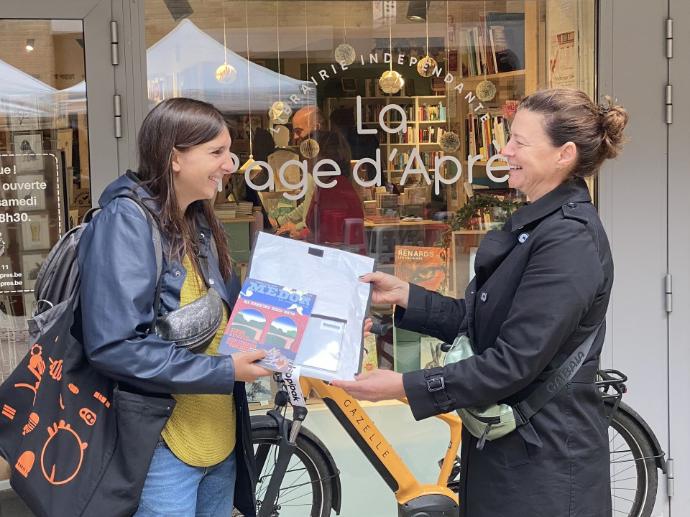
A special thank you to Tiffany, our contact at Médor, for her trust, her feedback and her willingness to experiment.
Reuse cannot simply be decreed.
It is built, one package at a time.
Book a meeting and discover Loopipak’s reusable packaging solutions for your business.
Contact us +32 470/876.641

Médor tests reusable packaging for deliveries to bookshops