Reusing packaging is an obvious solution to reduce waste. Companies that want to switch to reusable packaging all ask the same question:
How can we practically organize the return of packaging?
Unlike single-use packaging (linear economy), reusable packaging (circular economy) must return to the logistics loop to be used again. This step, known as reverse logistics, is at the heart of reusable packaging systems.
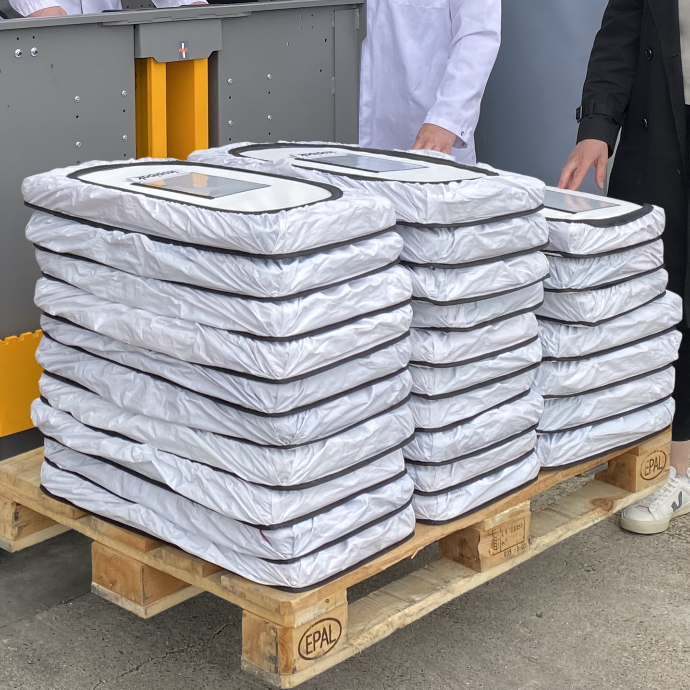
Why is organizing reverse logistics essential?
Reusable packaging is only truly sustainable if it circulates multiple times within a logistics flow.
The longer and more frequently a packaging is used, the lower its environmental impact. This is demonstrated by Life Cycle Assessments (LCA): environmental performance largely depends on the number of rotations.
The return process allows to:
- Recover packaging after use
- Put it back into circulation
- Avoid producing new packaging
When well organized, it becomes a natural part of existing logistics.
Different return models:
There is no single way to organize return flows. Companies usually rely on one of the following models.
1. Return during the next delivery:
This is one of the simplest and most cost-effective models.
When a truck delivers goods, it can collect empty packaging from the previous delivery.
This works particularly well in:
- Internal logistics
- Retail networks
- Regular deliveries
In these cases, logistics flows already exist: returns are integrated into delivery routes.
2. Collection points:
In some cases, packaging can be gathered at a central logistics hub.
Users drop off empty packaging, which is then collected in bulk.
This model is commonly used in:
- Multi-site logistics networks
- Logistics platforms
- Distribution centers
It optimizes transport by consolidating return flows.
3. Return via carrier:
In e-commerce or certain logistics chains, packaging can also be returned through standard carriers.
The packaging is:
- Folded
- Closed
- Sent back into the logistics loop
Key elements for an efficient system:
The success of reusable packaging relies on simple principles.
Design packaging adapted to logistics flows:
Reusable packaging must be designed to facilitate return.
This includes:
- Foldable packaging
- Reusable closing systems
- Lightweight packaging
- Formats compatible with pallets and vehicles
- Return label holders
- Clear signage
- Deposit systems
- Tracking systems
Integrate returns into existing flows:
Good design avoids the need to create entirely new logistics.
Returns can be integrated into:
- Delivery routes
- Empty truck returns
- Existing logistics flows
This is often the most efficient solution.
Track packaging within the system:
To avoid losses and optimize rotations, companies implement tracking systems.
This can include:
- Batch management
- Barcodes
- Digital tracking tools
These systems help manage flows, measure rotations and returns, track maintenance and repairs, and increase the number of rotations.
Reverse logistics: an organizational shift more than a technical issue:
In many projects, the challenge is not technical but organizational.
Switching to reuse means seeing packaging not as a consumable, but as an asset that circulates.
Once this mindset is adopted, managing returns becomes natural.
How does Loopipak support companies?
Implementing reusable packaging is not limited to product manufacturing.
Each project starts with a logistics flow analysis to understand:
- Transport routes
- Possible collection points
- Packaging volumes
- Potential rotations
Based on this, we design packaging adapted to real operational flows and support the implementation of return systems.
The objective is simple: enable packaging to circulate efficiently while reducing single-use packaging waste.
Towards circular logistics:
With evolving European regulations and growing pressure to reduce waste, reusable packaging systems will play an increasingly important role in logistics.
Reuse of packaging: How to organise return logistics