Introduction: three words... but not the same impact
In business, these three terms are constantly used interchangeably: recycling, reuse, and repurposing.
However, they describe three entirely different levels of environmental impact and economic performance.
Understanding this difference is essential for companies that want to truly reduce their environmental impact. Because not all solutions are created equal.
Choosing the right lever can make all the difference:
- Lower costs
- Less waste
- Improved logistics performance
1. Recycling: turning waste into new materials
Recycling involves transforming waste into a new raw material.
Common examples:
- Melted plastic used to make new objects
- Recycled paper used to make new cardboard boxes
- Aluminum is recycled to create new packaging
Recycling helps recover some of the value of the materials.
But one thing must be clearly understood: Recycling remains a resource-intensive industrial process.
It requires:
- Waste collection
- To transport them
- To sort them
- To wash them
- To process them industrially
All of this requires energy, water, and significant infrastructure.
Recycling is therefore preferable to incineration, but it is not the ideal solution.
In many cases, it also does not allow for infinite recycling: the materials often lose quality over the course of multiple cycles.
💡Key takeaway: Recycling is an end-of-life solution, not a fundamental solution.
2. Reuse: using an existing object without altering it
Reuse involves using an object as is, for a similar purpose, without any industrial processing.
Examples:
- A reusable shipping container
- a container that has been returned and put back into circulation
- a pallet used for multiple shipments
- a shipping container that moves between multiple locations
Reuse is extremely effective because it avoids the need to process the material.
The object retains its original function and simply continues to circulate.
The environmental benefits are therefore significant:
- No production of new materials, so no environmental impact
- No industrial transformation
- Less energy used
- Less waste generated
From an industrial perspective, reuse often relies on rotation and return systems.
This is the principle behind reusable logistics packaging.
3. Reuse: extending the life of an object for another purpose
Reuse involves giving a project a second life by repurposing it for a use other than its original function.
People also often talk about upcycling.
Examples:
- Turn an advertising banner into a bag or a cover
- Use recycled industrial straps to create new fastening systems.
- Reusing industrial materials to make new products
The material already exists.
Instead of being thrown away or recycled, it is incorporated into a new product.
Reuse therefore allows for:
- To avoid producing new materials
- To divert waste streams
- To create high-value-added circular products
This is a very interesting approach when the material still possesses excellent technical properties.
4. Why the hierarchy of solutions is important
In the circular economy, not all solutions are equally effective.
People often talk about the waste hierarchy
From most virtuous to least virtuous:
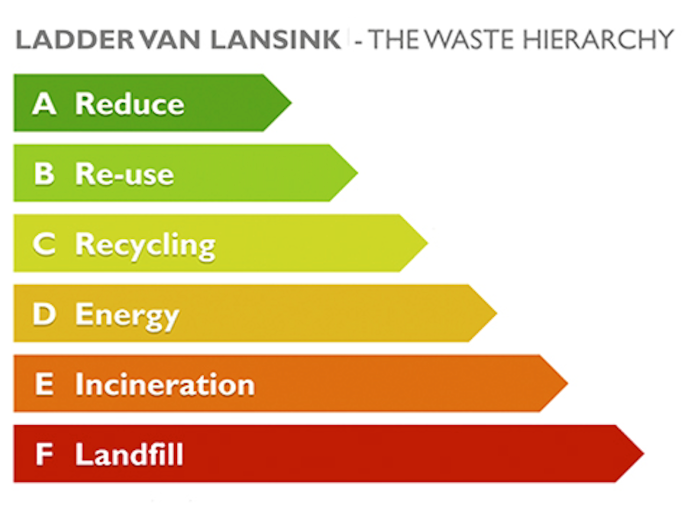
Why ?
Because the less we process the material, the smaller the environmental impact.
Recycling is still useful, but preventing waste in the first place is even better.
5. What this means for businesses
For businesses, this distinction completely changes the way they approach packaging.
For years, the most widely promoted solution was:
« Recycle packaging »
Today, the question is more like:
« How can we avoid producing this packaging? »
This involves, in particular:
- Reusable packaging
- Logistics return systems
- Materials built to last
- Repairable products
This is a significant shift: we are moving from a waste management approach to a waste prevention approach.
6. The Loopipak Approach: Combining Reuse and Recycling
At Loopipak, we operate precisely at the intersection of these two approaches: reuse and repurposing
Our solutions are based on two principles:
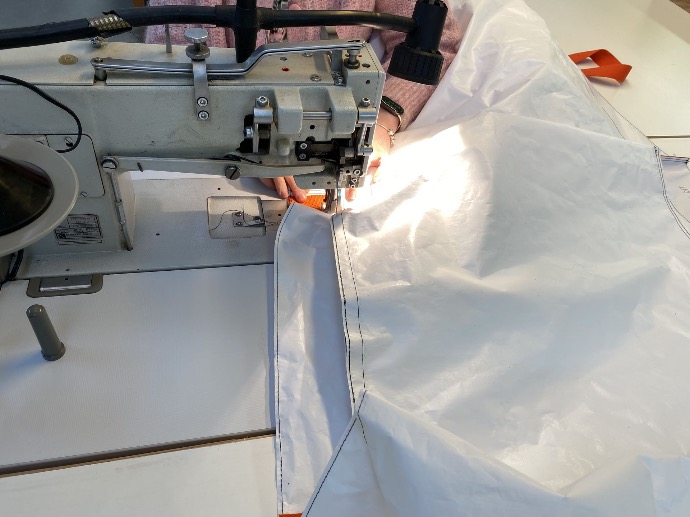
1. The reuse of industrial materials that have already been produced:
- Advertising banners
- Industrial straps
- Other durable technical materials
These materials are used to make components for circular logistics packaging.
2. Logistics Reuse
Our packaging is designed to be reused dozens of times:
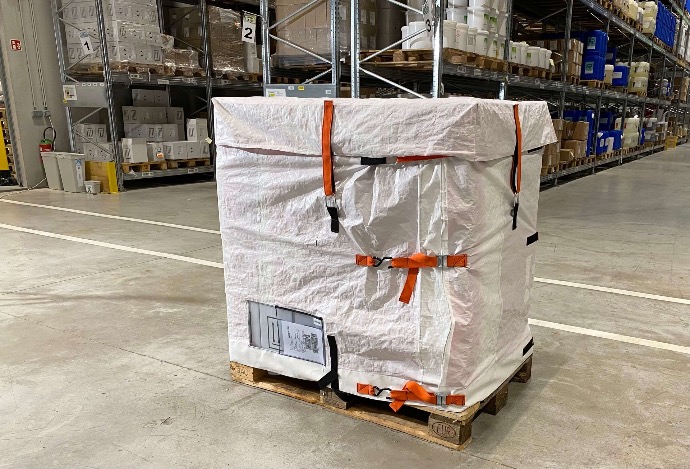
- Pallet covers
- Logistics boxes
- Transportation Solutions
- Bags and envelopes
The goal is simple: to replace disposable packaging with reusable items.
Conclusion: Recycling is no longer enough
Recycling should only be used as a last resort.
It is this shift in thinking that will enable the transition from a waste-based economy to a true circular economy.
Would you like to reduce packaging waste in your business?
Are you looking for reusable logistics solutions?
Contact Loopipak to analyze your logistics workflow and identify reusable alternatives that are suitable for your operations.
Recycling, Reuse, and Repurposing: What Are the Differences (and Why It Changes Everything in Logistics)