Replacing single-use packaging with reusable packaging raises an essential question:
How many times must a packaging be used to be truly reusable?
The answer depends on several factors: materials, logistics flows, packaging design, and transport distance. But one thing is certain: the environmental performance of reusable packaging depends on the number of rotations it can achieve.
The key principle: packaging rotation :
Reusable packaging works differently from single-use packaging. A single-use packaging is produced, used once, then discarded or recycled.
A reusable packaging is designed to circulate multiple times within a logistics flow.
Each additional use spreads the environmental impact of production over several usage cycles.
The longer a packaging is used, the lower its environmental impact per use.
The role of Life Cycle Assessment :
To measure the environmental performance of packaging, Life Cycle Assessment (LCA) is used.
This method allows comparison between:
- Single-use packaging
- Reusable packaging used multiple times
These analyses usually identify a break-even point: the moment when reusable packaging becomes more advantageous than single-use packaging.
This point varies depending on materials and logistics flows.
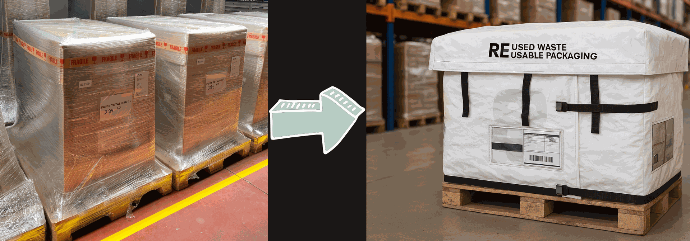
However, in many cases, only a few rotations are needed to achieve an environmental benefit. For Loopipak packaging, this break-even point is reached from the very first use.
The lifespan of reusable packaging :
Well-designed reusable packaging can be used dozens of times, sometimes much more.
Its lifespan depends on:
- Material quality
- Packaging design
- Conditions of use
- Repairability
In well-organized logistics systems, some packaging can reach several dozen rotations before being replaced. This extended use significantly reduces packaging waste.
The importance of eco-design :
To achieve a high number of uses, reusable packaging must be designed from the start to last.
Eco-design therefore plays a key role.
It includes:
- Material sourcing to reduce environmental pressure
- Durability
- Modularity
- Repairability
- Ease of folding and transport
- Compatibility with existing logistics flows
- End-of-life management
Poorly adapted packaging will be used less and therefore have less positive impact.
Reusable does not mean infinite :
It is important to remember that reusable packaging is not used indefinitely. Like any logistics equipment, it has a limited lifespan.
The goal is not to create an eternal packaging, but one capable of replacing as many single-use packaging items as possible. For example, a packaging used 30 times avoids the production and treatment of 30 single-use packaging units.
The role of logistics in performance :
The number of uses also depends on how packaging circulates within logistics flows.
A well-organized system allows:
- Easy recovery of packaging
- Optimization of rotations
- Reduction of losses
That is why implementing reusable packaging relies as much on logistics as on packaging design.
How Loopipak designs its reusable packaging ? :
Loopipak packaging is designed to integrate into existing logistics flows within companies.
Each project includes:
- A usage analysis
- A design adapted to logistics constraints
- Real-life testing before deployment
- Repair options to extend lifespan
This approach increases the number of rotations and maximizes both environmental and economic benefits.
A central question for the transition to reuse :
The number of uses is a key question in the transition toward reusable packaging systems.
It shows that packaging is no longer a simple consumable, but a logistics asset circulating within an organized system.
The better the system is designed, the longer packaging can be used. And the more companies can reduce their single-use packaging waste.
How many times does packaging need to be used before it can truly be considered reusable?