For a long time, packaging management relied on a simple model: use, dispose, and recycle.
However, with the increase in packaging waste and the limitations of recycling, the European Union is gradually changing its strategy.
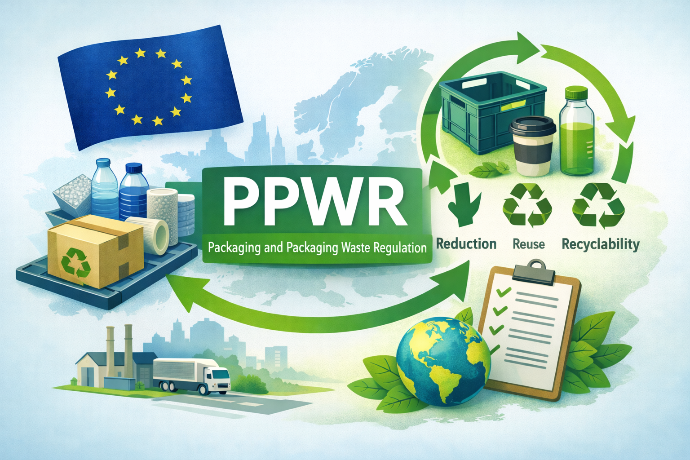
With the new European regulation on packaging, called the PPWR (Packaging and Packaging Waste Regulation), companies will need to reduce single-use packaging and develop more reusable packaging solutions.
For businesses, this regulatory evolution represents a significant change in the way they design and manage their logistics packaging.
So what will the European packaging regulation actually change for companies?
Why does the European Union want to develop packaging reuse? :
Every year, the European Union generates a very large amount of packaging waste.
According to European data, an average citizen produces more than 180 kg of packaging waste per year.
A large share of this packaging is used for only a few minutes before being discarded.
Although recycling has developed in recent years, it still has several limitations:
- not all packaging is recycled
- recycling consumes energy and resources
- some materials lose quality after several recycling cycles
For this reason, European waste policy now prioritizes reducing and reusing packaging before recycling.
The logic is simple: A package reused around ten times can significantly reduce waste production.
PPWR: the new European packaging regulation :
The PPWR (Packaging and Packaging Waste Regulation) is the future European regulation intended to more strictly regulate the management of packaging and packaging waste across the European Union.
Unlike previous directives, which required transposition into national legislation, the PPWR will take the form of a European regulation directly applicable in all Member States. This will harmonize rules across Europe and reduce regulatory differences between countries.
This regulation is part of the objectives of the European Green Deal and the Circular Economy Action Plan, which aim to reduce waste production and improve resource efficiency.
The main objectives of the PPWR include:
- reducing the total amount of packaging waste generated in the European Union
- improving the recyclability and circularity of packaging
- increasing the share of reusable packaging
- reducing the overall environmental footprint of packaging systems
This regulation will affect many economic sectors, including logistics, freight transport, distribution, and e-commerce, where volumes of single-use packaging remain particularly high.
Reuse targets for certain packaging :
Among the measures introduced by the PPWR is the progressive introduction of reuse targets for certain types of packaging.
These targets aim to increase the share of packaging designed to perform multiple use cycles within organized reuse systems.
The sectors concerned include:
- transport and logistics packaging
- certain packaging used in e-commerce
- certain packaging used in distribution and food servicesc
The objective of the regulation is to encourage the implementation of logistics systems enabling the circulation and recovery of reusable packaging, in order to reduce dependence on single-use packaging.
For companies, this means thinking about packaging solutions designed from the start to support multiple use cycles while maintaining their logistical performance and protective functions.
Increasing pressure on single-use packaging :
At the same time as reuse is being promoted, European regulation is gradually strengthening constraints on single-use packaging.
Several regulatory and economic mechanisms contribute to this evolution:
- extended producer responsibility (EPR) for packaging, requiring companies to finance the management of packaging waste
- the gradual increase in waste management and treatment costs
- the introduction of recyclability requirements for packaging
In this context, some disposable packaging solutions may become economically less competitive, especially when all management costs are taken into account.
This regulatory evolution is gradually encouraging companies to explore alternative models based on packaging reuse.
Packaging reuse: a transformation of logistics practices :
The transition to reusable packaging is not limited to replacing a material or packaging format.
It often requires adapting certain elements of the logistics system, including:
- the technical design of packaging
- durability and resistance to usage cycles
- ergonomics for logistics operators
- foldability and storage between cycles
- recovery and reintegration into logistics flows
In many cases, companies find that reusable solutions can optimize certain logistics flows while reducing the consumption of single-use packaging.
The economic benefits of reusable packaging :
Although regulation is an accelerating factor, the adoption of reusable packaging also relies on economic and operational logic.
Packaging designed for multiple cycles can:
- reduce recurring purchases of disposable packaging
- lower waste management costs
- improve control and traceability of logistics flows
- strengthen the consistency of corporate sustainability strategies
When the lifespan of reusable packaging reaches several dozen cycles, the cost per use can become lower than that of single-use packaging.
Measuring the environmental impact of packaging :
To compare different packaging solutions, companies increasingly rely on Life Cycle Assessment (LCA).
LCA is a scientific methodology used to evaluate the environmental impacts of a product across its entire life cycle.
In the case of packaging, it makes it possible to measure:
- greenhouse gas emissions
- resource consumption
- waste generation
- the overall environmental impact of the packaging system
Life Cycle Assessment therefore allows companies to compare the environmental performance of single-use packaging and reusable packaging within a specific logistics context.
Anticipating packaging regulation today :
Even though some obligations will be introduced gradually, the European regulatory trajectory clearly focuses on:
- reducing single-use packaging
- developing reuse systems
- improving packaging circularity
Companies that anticipate these changes can:
- test reusable packaging pilot projects
- gradually adapt their logistics flows
- reduce their packaging waste production
- strengthen their environmental and regulatory performance
How Loopipak supports companies in packaging reuse :
Implementing reusable packaging in logistics often requires an approach adapted to the operational constraints and specific flows of each company.
At Loopipak, we develop custom reusable packaging designed to replace single-use packaging in logistics flows.
We support companies through several stages:
- analysis of existing logistics flows
- design of suitable reusable packaging
- implementation of pilot projects
- evaluation of economic profitability
- comparative life cycle assessments
- monitoring and optimization of the reuse system
The goal is to enable companies to sustainably reduce their packaging waste while maintaining robust and operational logistics solutions.
Reuse of packaging: how European regulations will change things for businesses