For a long time, waste management relied on a simple model: produce, use, dispose.
Today, faced with climate urgency and increasing waste visibility, Europe is trying to transform this model. Decarbonization, recycling and reuse have become priorities.
But one essential question remains largely absent from the debate:
Can a logistics system truly become sustainable without reducing volumes?
1. Decarbonization: a technical response to a systemic problem :
Today, most efforts focus on optimization. Companies work on lower-emission materials, lighter packaging, and recyclable or reusable solutions. Supply chains are optimized, transport is rationalized, and performance is measured.
This dynamic is necessary. It reduces the impact of each individual package.
But it does not address the root of the problem.
While each package becomes more efficient, their number continues to grow. The rise of e-commerce, flow fragmentation and the multiplication of shipments are deeply transforming logistics.
The result is paradoxical: unit impact decreases, but total impact increases.
2. A blind spot: the growth of logistics flows :
The real blind spot in current policies lies in the growth of logistics flows.
Today, each product can be ordered, delivered, returned and shipped again. Supply chains are becoming faster, but also more complex. What used to be consolidated flows are now fragmented.
Less carbon per parcel does not mean less carbon overall.
This is a critical distinction that is still largely missing from current strategies.
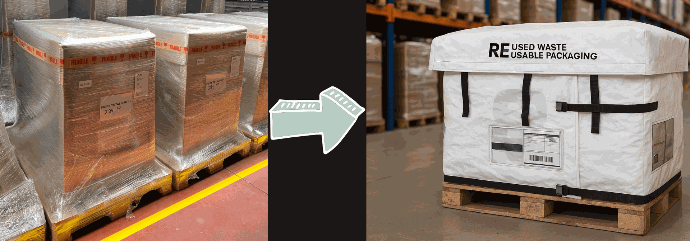
3. European regulation: improving without transforming :
The PPWR regulation marks an important step forward. It promotes the reduction of single-use packaging, sets reuse targets and strengthens recyclability requirements.
These measures clearly move in the right direction.
But they still mostly operate within a logic of improving the existing system. They question packaging performance, but rarely its necessity.
In other words: we aim to package better, without always questioning why and how much we package.
4. Reuse: a major step forward, but not an end goal :
Reusable packaging represents a structural shift. By allowing the same packaging to be used multiple times, it reduces waste and spreads production impact across several cycles.
Its performance relies on a simple principle: the more it circulates, the lower its impact.
But here again, a limitation appears.
Reuse improves system efficiency, but does not challenge its intensity. If flows keep increasing, even a reusable system can lead to higher overall impact.
Reuse is therefore a necessary condition for the transition.
5. Returning to the right level of thinking :
To truly reduce packaging impact, a shift in perspective is needed.
The question cannot remain purely technical. It must become systemic.
Before optimizing or replacing, we must ask:
- Is this packaging necessary?
- Can this flow be reduced?
- Is this logistics organization relevant?
These are the levers that enable real transformation.
6. From theory to action: the role of companies :
This is where companies play a key role. While regulations set the framework, operational decisions are what truly change practices.
Changing packaging is not enough. Uses, flows and circulation models must also be rethought. That is where the real challenge lies.
7. What Loopipak brings to this transition :
At Loopipak, we start from a simple conviction:
A systemic problem cannot be solved with a purely technical solution.
That is why we do not only offer reusable packaging, but support companies in a broader transformation.
We always begin by understanding existing flows, real uses and operational constraints. This step is essential to identify true impact levers.
We then design solutions tailored to these realities. Each packaging solution is built to integrate into operations, circulate efficiently and be easily returned.
We also work on packaging lifespan. Reusable packaging only makes sense if it is used long enough. This involves organizing returns, optimizing rotations and repairing when necessary.
Finally, we measure. We assess operational performance, economic profitability and environmental impact by comparing single-use and reusable systems.
A conviction: reduce before optimizing :
Decarbonization is essential.
Reuse is a major step forward.
But without reducing volumes, these efforts remain limited.
The real transition is not just about better packaging. --> It is about transporting less, better and more intelligently.
At Loopipak, this conviction guides our approach:
The real solution starts by reducing consumption.
Decarbonizing without reducing: why Europe is missing the packaging issue ?